
About Pellets
Choosing the right pellet stove
A first-time buyer’s guide to stove types, sizing, features, and price, from the people who deliver the fuel.
A pellet stove gives you the comfort of a real fire with close to the convenience of central heat. You pour in a bag of wood pellets, set the temperature, and the stove automatically feeds, lights, and regulates itself. Choosing the right one mostly comes down to three questions: where it will go, how much space it needs to heat, and how much automation you want.
This guide walks through each decision in the order most buyers face them. When you’re ready to compare models, head to our Pellet Stove Finder.
Pellet Stove vs. Wood Stove
Both burn wood, and both give you a real flame to look at. Beyond that they’re very different machines. A wood stove is a firebox you feed by hand. A pellet stove is a fully automated appliance that uses an auger to move pellet fuel from a hopper to a burn pot, a combustion fan supplies precisely the air the fire needs, and a convection blower pushes the heat into the room.
| Pellet stove | Wood stove | |
|---|---|---|
| Fuel | Clean 40-lb bags; a season’s supply stacks on a few pallets | Cordwood to buy or cut, split, stack, and season for 6–12 months |
| Refueling | Fill the hopper once a day or less | Add logs every few hours |
| Lighting | Push-button or automatic | Kindling, newspaper, and patience |
| Temperature control | Set a temperature; many models run on a thermostat | Adjust the air damper and guess |
| Smoke & efficiency | About 70–83% efficient; very low particulate emissions | Varies widely with wood moisture and how the fire is tended |
| Venting | 3″ or 4″ vent pipe, often straight out a side wall (similar to a dryer vent) | A full-height chimney |
| Electricity | Required (unless battery backup or a non-electric model) | Not needed; heats through a power outage |
To be fair to wood stoves: they need no electricity, have fewer moving parts, and can run on free wood (if you have acess to free cordwood). A pellet stove requires routine cleaning and an electrical outlet. For most households, though, the trade is easy. You get steady, controllable heat without the splitting, stacking, bark, bugs, and smoke.
The Main Types of Pellet Stoves
Start with where the heat needs to go. That usually decides the type for you.
- Freestanding stoves are the most common choice. They sit on a non-combustible hearth pad (sold separately) in almost any room near an outlet and vent through the wall or roof. This is the most flexible and usually the least expensive installation. Styles run from traditional cast-iron looks to sleek contemporary designs.
- Fireplace inserts slide into an existing masonry or factory-built fireplace and vent through a stainless-steel liner run up the chimney. An open fireplace sends most of its heat up the flue. An insert turns it into a real heat source. Measure your firebox opening, depth, and rear width before you shop, because inserts are sized to fit.
- Pellet furnaces and boilers replace or supplement an oil, gas, or propane central system. A furnace heats air for your ductwork. A boiler heats water for radiators, radiant floors, and often your domestic hot water. They usually live in a basement or utility room and can be fed from a large bin or a bulk storage tank refilled by truck.
- Multi-fuel stoves can burn wood pellets and other biomass fuels such as shelled corn. They offer flexibility, but check the manual: corn and other biomass produce more ash and need more frequent cleaning.
Top-fed vs. bottom-fed
Stoves also differ in how pellets reach the fire. Top-fed stoves drop pellets from above into the burn pot. The gap between the auger and the flame reduces the risk of burnback into the hopper, but ash can build up in the pot, so they reward low-ash premium fuel and regular scraping. Bottom-fed (and side-fed) stoves push pellets in from below or behind. The fresh fuel continuously nudges ash out of the burn pot, which gives a steadier flame and more tolerance for higher-ash fuel.
Power and outages
Nearly all pellet stoves need electricity to run the auger, fans, and controls. They use roughly as much power as a household light fixture once running, with a brief spike during ignition. If outages are common where you live, look for a model with a battery-backup option, or plan on a small UPS or generator. A handful of non-electric, gravity-fed models exist for off-grid homes.
Most New Stoves Light Themselves
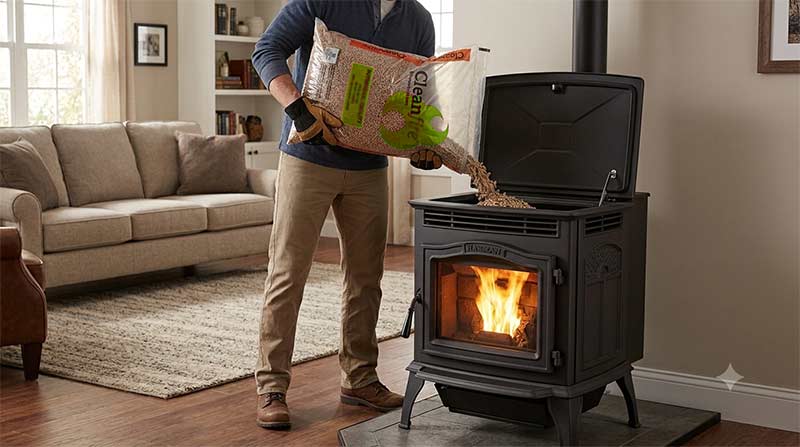
If your picture of a pellet stove involves fire starter gel and a long lighter, it’s out of date. Nearly every new pellet stove has automatic ignition. A small electric igniter (a hot rod or ceramic element) heats air blown across the pellets in the burn pot until they catch, usually within a few minutes. No kindling, no matches.
Auto-ignition is what makes the rest of a pellet stove’s automation possible. The stove can start on a timer before you get up, shut down when you leave, and relight itself whenever the thermostat calls for heat. On a manual-light stove, the fire has to stay lit around the clock.
Thermostats: Even Heat, Where You Live
Many new stoves run from a built-in room sensor or a wall thermostat, just like a furnace. The best of them go a step further. Instead of simply switching on and off, they modulate: they gradually turn the feed rate and blower up or down to hold the temperature you set.
That’s a real comfort advantage over a typical oil or gas furnace. A conventional furnace runs full blast until the thermostat is satisfied, shuts off, and waits for the house to cool before it fires again, so you feel the swing. A modulating pellet stove keeps a low, steady fire that closely matches the heat your room is losing. The temperature stays remarkably even, without the blasts of hot air and the cool-downs in between.
Features worth looking for:
- Thermostat modes: modulating (the stove stays lit and adjusts) and on/off (the stove shuts down and relights). Good controls offer both.
- Programmable schedules: lower the heat overnight or while you’re at work, then warm up before you’re home.
- Remote and Wi-Fi control: a handheld remote with a built-in sensor, or an app that lets you check and adjust the stove from anywhere.
Hopper Capacity and Burn Time
The hopper is the stove’s built-in fuel tank, and its size decides how often you refill. Freestanding stoves typically hold 40 to 130 lbs, inserts somewhat less, and furnaces and boilers more. Most stoves burn between about 1 lb per hour on low and 4–5 lbs per hour on high.
| Hopper size | On low (~1 lb/hr) | Medium (~2.5 lb/hr) | On high (~4.5 lb/hr) |
|---|---|---|---|
| 40 lbs (1 bag) | ~40 hours | ~16 hours | ~9 hours |
| 60 lbs | ~2½ days | ~24 hours | ~13 hours |
| 80 lbs (2 bags) | ~3½ days | ~32 hours | ~18 hours |
| 120 lbs (3 bags) | ~5 days | ~2 days | ~27 hours |
Approximate. Actual burn rates vary by stove, heat setting, and fuel.
A bigger hopper means fewer trips with a bag, and it matters most if the stove is your primary heat or you’re away for long days. Ask about the hopper extension kits many manufacturers offer. Also check that the hopper lid is at a comfortable height for lifting a 40-lb bag.
Big Differences in Quality and Price
Two pellet stoves with the same heat rating can differ in price by thousands of dollars. The gap is real, and it shows up over years of use rather than on the showroom floor. Typical ranges before installation:
| Category | Typical price | What you generally get |
|---|---|---|
| Entry-level stove | $1,500–$2,500 | Lighter steel, basic controls, smaller hopper, shorter warranty; often sold at big-box stores |
| Mid-range stove | $2,500–$4,000 | Heavier construction, auto-ignition, thermostat control, better ash handling |
| Premium stove | $4,000+ | Cast or heavy-gauge steel, modulating controls, quiet operation, large hopper, long warranty |
| Fireplace insert | $2,500–$5,000 | Plus a stainless chimney liner |
| Furnace or boiler | $5,000–$15,000+ | Whole-home heat; bulk fuel storage adds cost |
| Installation & venting | $500–$2,500 | Depends on vent run, hearth pad, liner, and permits |
Typical U.S. ranges; prices vary by region and dealer.
Where the extra money goes:
- Build quality: thicker steel or cast iron, heavier firebox components, and a sturdier auger and motor that hold up to decades of heating seasons.
- Combustion design: burn pots and air paths that handle ash well, burn cleanly across the whole heat range, and keep the glass clear longer.
- Controls: true modulating thermostat control, automatic shutdown and relight, and more accurate feed-rate control.
- Noise: fans and augers vary a lot. If the stove is going in a living room or bedroom, listen to one running before you buy.
- Warranty and support: longer coverage on the firebox and electronics, and available replacement parts years down the road.
Our advice: buy from a local hearth dealer who installs and services what they sell. A good dealer will size the stove to your home, handle permits and venting, and be there for the annual cleaning. A bargain stove with no one to service it rarely stays a bargain.
How to Size a Pellet Stove for Your Home
Pellet stoves are rated by heat output in BTUs per hour. As a rule of thumb, a stove rated around 42,000 BTU heats about 1,300 sq ft, and one around 60,000 BTU heats about 2,000 sq ft. Start with the area you actually want to heat, not the whole house:
A room, cabin, or small ranch
Main living floor of most homes
Open-plan home, primary heat
Largest stoves; consider a furnace
Starting points for an average, reasonably insulated home. Over 2,500 sq ft, a pellet furnace or boiler is usually the better fit.
Then adjust for your house:
- Climate: in northern New England, northern New York, and similar cold climates, size toward the top of the range. In milder areas, the low end is often plenty.
- Insulation and drafts: an older, drafty home with single-pane windows can need 25–50% more heat than a tight, well-insulated one of the same size.
- Ceiling height: cathedral ceilings and tall rooms add volume that has to be heated, so size up.
- Floor plan and placement: a stove in a central, open room moves heat through the house far better than one in a closed-off corner. Heat rises, so a stove on the lowest lived-in floor helps heat the floor above.
- Primary or supplemental heat: if the stove is taking over from your furnace, size generously. If it’s there to take the edge off in one or two rooms, a smaller stove will do.
Two sizing tips that save buyers the most trouble:
- Compare the right number. Manufacturers often advertise a maximum input BTU. The EPA-tested output and efficiency, found on the EPA label or in the certified wood heater database, are a fairer comparison between models.
- Don’t oversize. A stove that’s too big for the space spends its life idling on low, which is less efficient, dirties the glass, and builds up ash faster. When in doubt, have a dealer do a proper heat-loss estimate.
How Many Pellets Will You Use?
At an average heat setting, one 40-lb bag of pellets lasts about 24 hours. Over a season, most homes burn 2 to 5 tons (100 to 250 bags), depending on your climate, home size, and whether the stove is primary or supplemental heat. About three tons is typical for a stove that carries most of the load in a Northeast home.
One ton of pellets delivers roughly the heat of 120 gallons of heating oil. Estimate your savings with our calculator, and when you’re ready, we’ll deliver your season’s fuel.
Other Things to Know Before You Buy
- Look for EPA certification. New pellet stoves sold in the U.S. must meet EPA’s 2020 emissions standard. Certified stoves burn cleaner and more efficiently, and certification is usually required for state rebate programs.
- Plan the location. You’ll need a grounded outlet nearby, the manufacturer’s required clearances to walls and furniture, a non-combustible hearth pad, and a vent path to the outside. Pick a spot where heat can circulate into the rest of the house.
- Venting and outside air. Pellet stoves use special “PL” vent pipe and can often vent directly through a side wall. Codes set minimum distances from windows, doors, and walkways. An outside-air kit, which draws combustion air from outdoors, is recommended in tight homes and required in some locations, such as mobile homes.
- Permits, codes, and insurance. Most towns require a permit and inspection. Tell your homeowner’s insurance company about the installation; some insurers require professional installation.
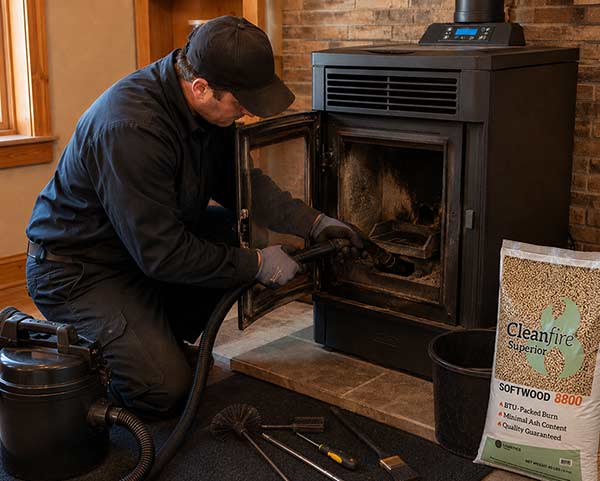
- Routine maintenance. Expect to scrape the burn pot every day or two, empty the ash pan every week or so when burning often, wipe the glass, and have the stove and vent professionally cleaned once a year. Door and hopper gaskets should be checked each season.
- Fuel quality matters. Even a great stove runs poorly on poor fuel. Look for PFI-certified, low-ash, low-fines pellets and store them dry. See our guides to quality pellets, why pellets differ, and pellet storage.
- Check for incentives. The federal tax credit for biomass stoves (Section 25C) ended for equipment installed after December 31, 2025, but many states and utilities still offer rebates for efficient pellet appliances. Check your state energy office before you buy; some programs require pre-approval.
Ready to shop?
Compare models side by side, or find a local dealer who can size and install one for you.
Frequently Asked Questions
Can a pellet stove heat my whole house?
A properly sized stove can heat an open-plan home of up to about 2,000–2,500 sq ft, especially when it’s centrally located. Homes with many closed-off rooms or multiple floors often keep their central system for backup, or choose a pellet furnace or boiler for true whole-home heat.
What happens to a pellet stove in a power outage?
Most pellet stoves need electricity, so they shut down safely when the power goes out. Many models offer a battery-backup option, and a small generator or UPS can also keep them running because they draw relatively little power.
How often do I need to fill a pellet stove?
It depends on the hopper size and heat setting. Most people fill their stove once a day during cold weather. A large hopper on a low setting can run for several days.
Can I install a pellet stove myself?
Some homeowners do, but we recommend professional installation. Venting clearances, permits, and inspections all apply, and some insurers and manufacturer warranties require a certified installer.
Should I burn hardwood or softwood pellets?
Either works in a pellet stove. Softwood pellets often burn slightly hotter, and quality matters far more than species. Read our hardwood vs. softwood comparison.
How long does a pellet stove last?
A well-built, well-maintained pellet stove commonly lasts 15–20 years or more. Igniters, gaskets, and fan motors are routine replacement parts along the way.
Sources & further reading
- Pellet Fuels Institute (PFI) / pelletheat.com, “Choosing the Right Pellet Stove”: stove types, feed styles, sizing rules of thumb, and fuel consumption.
- U.S. EPA Burn Wise: pellet stove operation, 2020 New Source Performance Standards, and the certified wood heater database.
- U.S. Department of Energy, Energy Saver: “Wood and Pellet Heating.”
- Massachusetts Department of Energy Resources, Wood Pellet Guidebook: fuel energy equivalence.