
About Pellets
What’s so green about wood pellets, anyway?
Wood pellets are one of the most environmentally friendly ways to heat a home — because pellet fuel is, at its heart, a recycling success story.
The vast majority of the raw material in wood pellets isn’t cut from trees. It’s clean sawdust and wood shavings — the leftover byproduct of lumber mills and wood product manufacturing. For decades, much of that material was treated as waste: buried in landfills or simply burned off. Today it’s recycled into one of the cleanest-burning heating fuels available.
A Fuel Made From What We Used to Throw Away
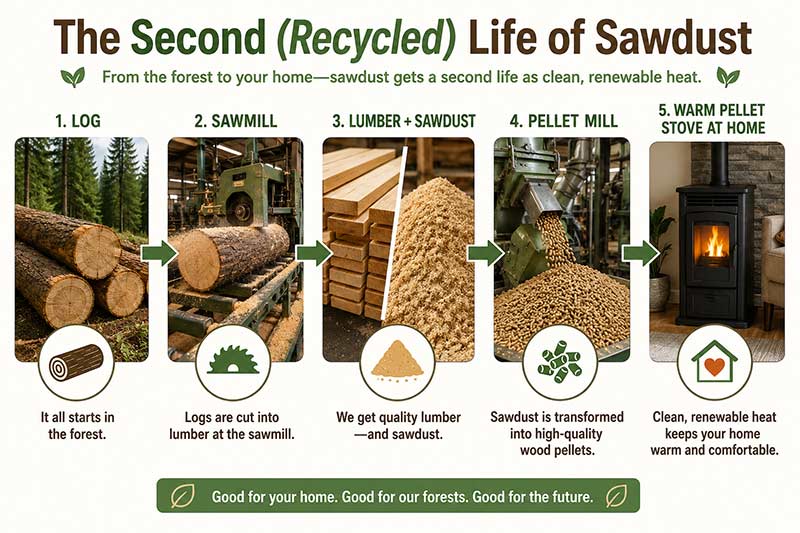
When a sawmill turns logs into lumber, a meaningful share of every log becomes sawdust, shavings, and chips. Before the pellet industry existed, mills had few options for those residues — vast quantities were landfilled or incinerated as waste.
Here’s the part most people never consider: wood waste buried in a landfill doesn’t just disappear. As it decomposes without oxygen, it releases methane — a greenhouse gas roughly 28–36 times more potent than CO₂ over a century.3 Turning that same sawdust into heating fuel puts its stored energy to work displacing fossil fuels instead of letting it rot underground.
Pellet fuel gives sawdust a second life: yesterday’s mill waste becomes today’s home heat.
And nothing artificial is added along the way. Wood pellets are 100% natural — no binders, chemicals, or additives. The natural lignin in wood fiber, activated by heat and pressure at the mill, is the only ‘glue’ holding a pellet together.
The Carbon Story, Honestly Told
Trees absorb CO₂ as they grow. When wood burns — or rots on the forest floor, or decomposes in a landfill — that same biogenic carbon returns to the atmosphere, where growing forests absorb it again. Fossil fuels are different: their carbon has been locked underground for millions of years, and burning them adds new carbon to the cycle.
But we won’t pretend pellets are magically ‘zero carbon’ — harvesting, manufacturing, and delivery all take energy. What does the full picture look like? Independent researchers at the University of New Hampshire measured the complete lifecycle of northeastern U.S. wood pellet heat — sourcing, processing, and transport included — and found pellet fuel cuts greenhouse gas emissions by 54% versus heating oil and 59% versus natural gas.4 And pellets made from sawmill residues — the kind that dominate home heating fuel — showed the strongest benefits of all, with studies of residue-based fuel finding reductions of 65% or more.5
In real terms: every ton of pellets you burn instead of oil keeps roughly 1,500 pounds of net greenhouse gas out of the atmosphere.4 Heat with three tons a season and you’re saving about two metric tons of CO₂ — like taking your car off the road for five months.6
| One ton of wood pellets replaces… | And that matters because… |
|---|---|
| ≈ 120 gallons of heating oil | That’s about 2,700 lbs of fossil CO₂ that never leaves the ground.1 2 |
| ≈ 170 gallons of propane | Propane is a fossil fuel extracted from natural gas processing. |
| ≈ 16,000 ft³ of natural gas | Every therm displaced is fossil carbon and methane leakage avoided. |
| ≈ 4,800 kWh of electricity | In much of the country, that electricity still comes partly from fossil fuels. |
Table sources: MA DOER Wood Pellet Guidebook (energy equivalence); EIA carbon coefficients.
Clean Combustion
Modern pellet appliances are precision heating machines. Because the fuel is dry, uniform, and fed at a controlled rate with forced-air combustion, pellet stoves burn remarkably clean and efficient:
- Efficient: EPA-certified pellet stoves typically operate at 70–83% efficiency (HHV) — with the best models at the top of that range.7
- Low smoke: a modern pellet stove emits a small fraction of the particulates of an old, non-EPA wood stove — up to 50 times less — and two to five times less than even newer EPA-certified cordwood stoves.8
- No sulfur, no mercury: unlike heating oil, wood pellets contain virtually no sulfur — so no meaningful sulfur dioxide emissions — and none of the mercury associated with some fossil-fuel electricity generation.9
Check your stove’s exhaust on a cold day: a properly running pellet stove produces little more than a heat shimmer.
Sustainable Forestry, Not Deforestation
Because pellet mills run primarily on manufacturing residues, home heating pellets don’t drive deforestation. The lumber industry cuts trees to build homes and furniture; pellet fuel simply captures the leftovers.
Where roundwood is used, it’s typically low-grade wood from managed forests — thinnings and cull trees that improve forest health — and in some regions, the forest service partners with the pellet industry to remove standing dead trees that would otherwise fuel wildfires. Healthy, actively growing forests absorb carbon faster than stagnant ones, and strong markets for low-grade wood help keep working forests forested instead of converted to development.
Local Fuel, Local Benefits
There’s an environmental bonus that rarely makes the brochures: distance. Most pellets burned in the Northeast are made in North America from regional wood fiber — not shipped across oceans or pumped through continental pipelines. Shorter supply chains mean lower transport emissions, and your heating dollars support regional mills and forestry jobs instead of overseas oil production.
Even the end of the pellet’s life is useful: the small amount of ash your stove produces is a natural, chemical-free source of potash — many of our customers spread it right on the garden.
The Bottom Line
- Made primarily from recycled sawmill residues that once went to landfills.
- 100% natural — no binders, chemicals, or additives.
- 54% lower lifecycle greenhouse gas emissions than heating oil — 65%+ for residue-based pellets.
- A fraction of the particulate emissions of traditional wood stoves.
- Virtually no sulfur or mercury.
- Renewable, regional, and it keeps working forests working.
Green doesn’t have to mean compromise. With premium pellet fuel, the environmentally responsible choice is also the one that keeps your home warmest for the money.
Frequently Asked Questions
Are wood pellets environmentally friendly?
Yes. Wood pellets are made primarily from recycled sawmill residues, are 100% natural with no additives, and cut lifecycle greenhouse gas emissions by roughly half compared to heating oil — more when made from mill residues.
Are wood pellets carbon neutral?
Not perfectly — and honest math matters. Burning pellets returns carbon to the atmosphere that trees recently absorbed, unlike fossil fuels which add ancient, locked-away carbon. Counting all sourcing, manufacturing, and delivery emissions, independent research finds pellet heat produces about 54% less greenhouse gas than heating oil.
Do wood pellets cause deforestation?
Home heating pellets are made mostly from sawdust and shavings — byproducts of lumber manufacturing — not from cutting trees for fuel. Where whole wood is used, it’s typically low-grade or fire-hazard wood from managed forests.
What happens to sawdust if it isn’t made into pellets?
Historically, much of it was landfilled or burned as waste. Buried wood waste decomposes into methane, a greenhouse gas 28–36 times more potent than CO₂ — one more reason recycling it into fuel is the better path.
Are pellet stoves clean burning?
Very. EPA-certified pellet stoves typically run at 70–83% efficiency and emit a small fraction of the smoke of traditional wood stoves — up to 50 times less particulate matter than old, uncertified stoves.
Sources
- Massachusetts Department of Energy Resources — Wood Pellet Guidebook (energy equivalence figures).
- U.S. EIA, Carbon Dioxide Emissions Coefficients: distillate heating oil ≈ 22.5 lbs CO₂/gallon × ~120 gallons.
- U.S. EPA, Understanding Global Warming Potentials: methane GWP 28–36 over 100 years.
- Buchholz, Gunn & Sharma (Univ. of New Hampshire), “Greenhouse gas emissions of local wood pellet heat from northeastern US forests,” Energy (2017): 54% reduction vs. #2 heating oil, 59% vs. natural gas (100-yr horizon).
- Lifecycle Associates analysis: wood pellets/chips reduce GHG emissions 65–100%+ vs. heating oil, strongest for sawmill residue feedstock.
- U.S. EPA Greenhouse Gas Equivalencies: typical passenger vehicle ≈ 4.6 metric tons CO₂/year; 3 tons pellets vs. oil ≈ 2.0 metric tons saved ≈ 5 months of driving.
- U.S. EPA Burn Wise, certified wood heater database: certified pellet stove efficiencies typically 70–83% HHV.
- Particulate comparison: EPA Burn Wise emissions data, pellet stoves vs. uncertified (~30+ g/hr) and certified cordwood stoves.
- Northeast Biomass Thermal Working Group — Heating the Northeast Vision (sulfur/mercury displacement).